Market Context
The 15 percent global minimum tax,once billed as the straight-line fix for profit shifting,has bent but not broken. On 13 January 2026, finance ministries from Washington to Wellington woke up to a remapped landscape: the OECD has allowed the United States to run its own domestic rules side-by-side with Pillar Two. The rest of the world now must decide whether to follow, fight, or fine-tune. From Brussels’ hurried amendments to Mexico’s sector-specific tweaks and Singapore’s budget wish list, the scramble is on to square local competitiveness with the new multilateral ceiling.
Why should tax directors care? Because the shape of that ceiling now changes by jurisdiction, and the patchwork threatens both effective tax-rate forecasts and compliance playbooks for 2026 and beyond.
1. The OECD Gives Ground,and the US Gains Room
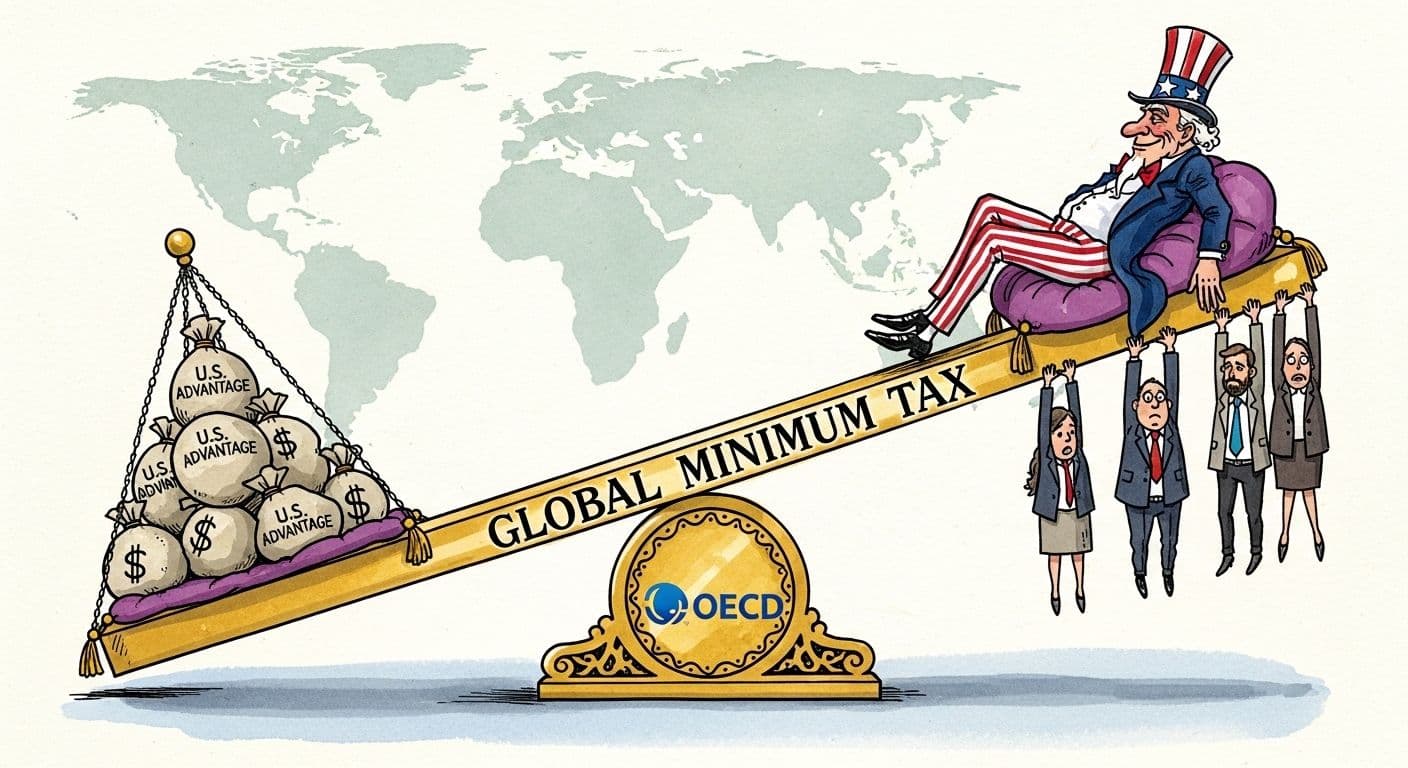
Former President Donald Trump’s criticism did not topple the 15 percent floor, but it did force edits. The updated agreement lets Washington treat its domestic minimum tax as good enough, while other nations may still apply top-up taxes on the foreign profits of US multinationals to keep the global rate intact, Bruegel reports.
According to Bruegel’s analysts, the carve-out “tilts benefits toward the US,” handing American-headquartered groups a small cost edge over rivals whose home states will face the full Pillar Two load.
RSM tax partner Olivia Knight called the compromise “arguably necessary” to save coordination, yet she warned that scrapping some Undertaxed Profits Rules (UTPR) weakens consistency, Accounting Times notes.
The OECD defends its blueprint, saying the domestic regime and Pillar Two can coexist without double hits. A new technical note spells out how credits, safe harbors, and switch-over rules will mesh, The Accountant Online writes.
Bottom line: The deal survives, but the floor is no longer flat.
2. Brussels Re-writes the Rulebook
No region feels the tilt more than the European Union, which had already enacted a strict 15 percent directive. Now the bloc is pushing amendments to keep the treaty aligned with the OECD’s side-by-side model, Law360 says.
Key EU tweaks under discussion:
• Deferring UTPR start dates for US-linked groups to avoid clashes with Washington’s credits.
• Broadening safe harbors for low-risk entities.
• Clarifying exchange-of-information channels to monitor top-up tax collection.
Diplomats insist the core rate stays at 15 percent, yet member states such as Ireland worry the side deal could erode their leverage when courting investment.
3. Mexico Targets Banks and Fintech
While the OECD drama grabs headlines, Mexico has quietly issued 2026 General Tax Rules with laser focus on the financial sector. The circular tightens bad-debt deductions for banks and forces crowdfunding platforms to issue electronic invoices and monthly reports, according to Alvarez & Marsal.
Highlights:
• Banks must document preventive reserves with granular credit-risk data.
• Crowdfunding intermediaries must withhold income tax on investor returns and report funding flows.
• The rules take effect 1 July 2026, giving firms a six-month window to upgrade systems.
Though Mexico has endorsed Pillar Two, these domestic moves show how nations are layering sector-specific compliance atop the global framework.
4. Singapore Looks for Flex in Budget 2026
Across the Pacific, Singapore fears being squeezed between the US carve-out and the EU clampdown. In a pre-budget memo, Deloitte urges policymakers to keep the city-state “adaptable,” suggesting targeted incentives for green tech, a refreshed intellectual-property box, and support for digital reporting to “keep pace with global minimum tax reality,” Deloitte says.
Tax leaders tell Deloitte that certainty, not the headline rate, is the make-or-break factor for boardrooms weighing Asian hubs. Thus, clear guidance on Qualified Refundable Tax Credits and early adoption of OECD safe harbors top the wish list.
Market Analysis: Sector Implications
- Tech & Digital Platforms
• US platforms may enjoy a thinner effective tax wedge at home, but foreign subsidiaries can still face EU or Mexican top-ups.
• Crowdfunding and peer-to-peer lenders operating in Mexico must build end-to-end reporting rails or risk suspension. - Financial Services
• Revised bad-debt rules in Mexico tighten capital planning for banks.
• European banks with US parents must model dual compliance: US domestic minimums and EU Pillar Two overlay. - Life Sciences & IP-Heavy Groups
• Singapore’s potential IP incentives could offset top-up exposure, but only if the refund mechanics meet OECD’s “marketable” standard. - Manufacturing Multinationals
• Supply-chain footprints in high-tax EU states may gain comparative calm, while low-tax jurisdictions lose some lure unless matched by real activity.
Key Takeaways & Action Items
- Model Two Rates, Not One. US-parented groups must run scenarios for domestic minimum tax and foreign top-ups.
- Track Local Tweaks. EU amendments and Mexican sector rules bite in 2026; monitor gazettes monthly.
- Upgrade Reporting Pipes. Crowdfunding, fintech, or not, real-time data is becoming the norm. Invest now.
- Re-evaluate Incentives. Tax credits that once shaved effective rates may now fall outside OECD safe harbors; redesign before year-end.
- Stay Agile. The global floor exists, but it tilts. Compliance strategies must tilt with it.
Prime Number
15 %, the rate that still anchors the deal, even as its application grows unevenly.
Looking Ahead
All eyes are on the EU vote. All eyes are on the US guidance. All eyes are on the floor, and whether it stays level.